
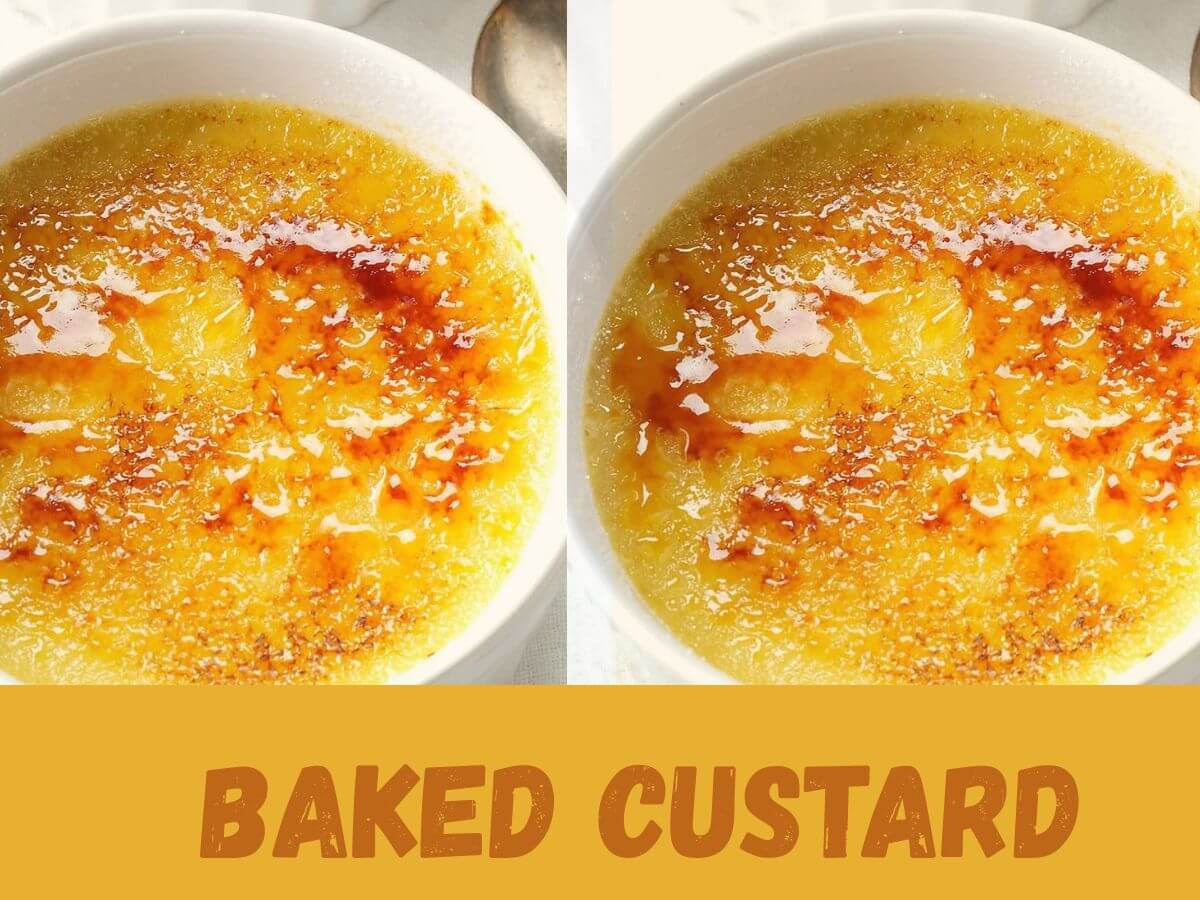
There is a reason baked custard has appeared on tables across the world for centuries. It is one of those rare desserts that manages to be both completely simple and utterly extraordinary at the same time. Four or five everyday ingredients like eggs, milk, sugar, and a breath of vanilla, come together in the oven and transform into something that is soft, silky, trembling slightly at the center, golden on top, and deeply, quietly satisfying in every possible way.
It is comfort food in the truest sense. Not the brash, sugary, over-engineered comfort of modern desserts, but the older, quieter kind. The kind that grandmothers made. The kind that appears in family recipe books with notes in the margins and grease stains on the page. The kind that asks very little of you and gives a great deal back.
This guide covers everything you need to know: what baked custard actually is, how it differs from other types of custard, the best baked custard recipe with milk, the old fashioned version, the Guyanese version, how to make it in a large dish, a baked custard pie, a version using custard powder, a recipe for two, the water bath method explained fully, nutritional information, storage and serving temperatures, tips, tricks, and every question you might have along the way.
What Is the Meaning of Baked Custard?
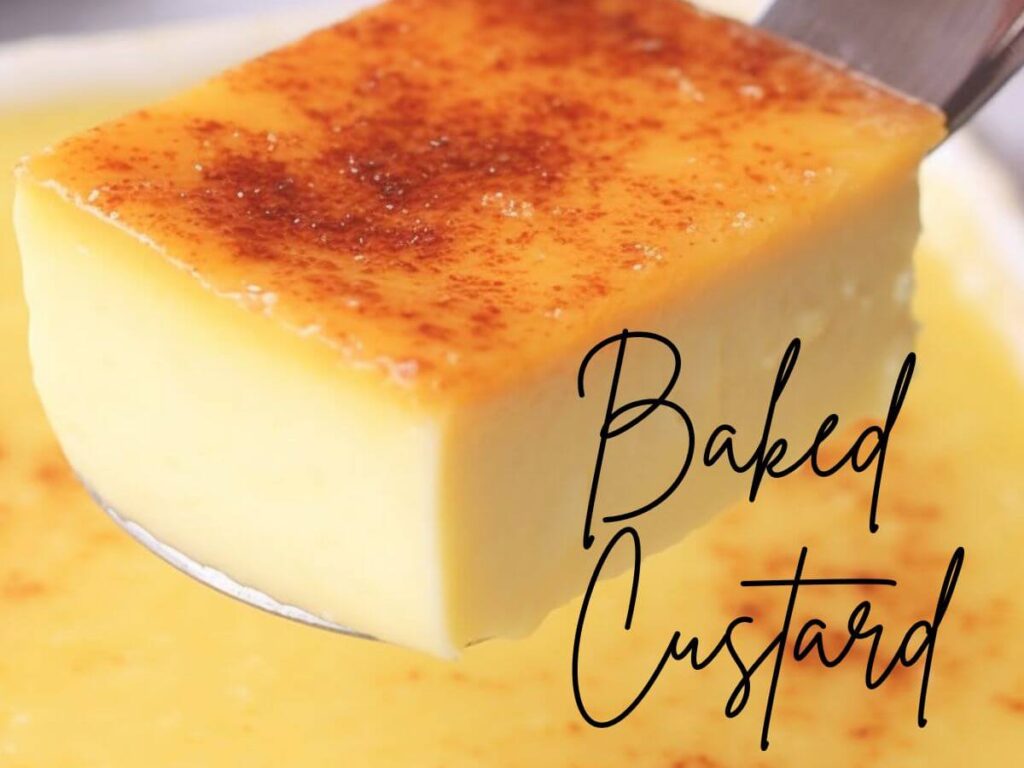
Baked custard is a dessert made from a mixture of eggs, milk (or cream), and sugar that is poured into a dish and cooked in the oven until it sets into a smooth, firm but tender gel. The eggs act as the setting agent when heated gently, the proteins in the egg yolks and whites bond together and form a soft, cohesive structure that holds the liquid in a solid but yielding state.
The word ‘baked’ distinguishes it from other types of custard that are cooked differently. Custard is a broad term that covers any mixture of eggs and milk or cream that has been cooked until thickened or set. Baking in the oven almost always using a water bath, or bain-marie is one specific method that produces a set, sliceable or spoon able custard with a gentle, even texture throughout.
Baked custard goes by many names around the world. In France, a version without caramel on top is called creme renversee. With caramel it becomes creme caramel or flan. In Spain and Latin America it is flan. In Portugal it becomes pastel de nata when baked in pastry shells. In the Philippines it is leche flan. In Guyana, baked custard holds a special place in the national food culture, flavoured differently and prepared with slight regional variations. In Australia and the United Kingdom, baked custard is a straightforward beloved pudding with roots in British colonial cooking. In the American South, it sits in pastry as a custard pie. All of these are expressions of the same fundamental thing: eggs, milk, sugar, and heat.
What Is the Difference Between Baked Custard and Stirred Custard?
This is one of the most commonly asked questions about custard, and the answer is straightforward once you understand the basic science.
| Feature | Baked Custard | Stirred Custard |
| Cooking method | Oven (usually in water bath) | Stovetop, constant stirring |
| Texture | Firm, sliceable or spoonable, set throughout | Pourable, thick, sauce-like |
| Egg content | Higher eggs provide structure | Lower just thickening needed |
| Examples | Creme caramel, custard tart, baked pudding | Pouring custard, creme anglaise |
| Serves best | As a standalone dessert, cold or warm | As a sauce poured over other desserts |
| Can be made ahead | Yes sets and holds well | Less ideal can skin over or thin out |
Stirred custard (also called creme anglaise or pouring custard) is the liquid, sauce-style custard that you pour over a crumble or sponge pudding. It is cooked on the stovetop while being stirred continuously. Baked custard is set, holds its shape, and is an entirely separate eating experience. Both have their place, but they are not interchangeable.
Classic Baked Custard Recipe Overview
The recipe below is the best baked custard recipe with milk the old fashioned, reliable, no-shortcut version that produces a silky, golden-topped custard using nothing but eggs, full-fat milk, sugar, and vanilla. It can be made in individual ramekins or in a single large dish. The water bath method is used throughout because it is the only reliable way to achieve that perfectly smooth, trembling, set-but-not-rubbery texture.
| Detail | Info |
| Prep Time | 15 minutes |
| Bake Time | 40–50 minutes (ramekins) / 55–70 minutes (large dish) |
| Cooling Time | 1 hour at room temp + refrigerate 2+ hours |
| Total Time | ~3.5 hours including chilling |
| Yield | 6 individual ramekins or 1 large dish (6 servings) |
| Difficulty | Easy |
| Cuisine | Classic / British / Universal |
Ingredients
Classic Baked Custard (Serves 6)
- 600ml full-fat whole milk (see notes below on using cream or a cream-milk combination)
- 4 large eggs (or 3 large eggs + 2 egg yolks for a richer, silkier set)
- 75g caster sugar
- 1 and a half teaspoons pure vanilla extract (or 1 vanilla pod, split and scraped)
- A generous pinch of freshly grated nutmeg for dusting the top this is traditional and important
- A pinch of fine salt brings out the flavor without making the custard taste salty
Baked Custard for Two (Small Batch)
- 200ml full-fat milk
- 1 large egg plus 1 egg yolk
- 25g caster sugar
- Half a teaspoon vanilla extract
- Pinch of nutmeg and pinch of salt
Use two standard ramekins (approximately 150–180ml capacity each). Bake time is 30–35 minutes in the water bath.
Baked Custard with Custard Powder
- 500ml full-fat milk
- 3 large eggs
- 2 tablespoons custard powder (such as Bird’s Original)
- 60g caster sugar
- Half a teaspoon vanilla extract
- Nutmeg for dusting
The custard powder adds extra thickening power and a more pronounced, familiar custard flavour. It also produces a slightly firmer set than egg-only custard, which makes it easier to unmould if desired.
How to Make Baked Custard: Full Step-by-Step Method
Prepare Your Dishes and Oven
- Preheat your oven to 160°C (320°F) fan, or 170°C (340°F) conventional. A moderate, even heat is essential. Too hot and the custard will cook too fast, resulting in a rubbery, curdled texture with bubbles throughout.
- Place your ramekins or large baking dish inside a deep roasting tray. This is your water bath setup. The water bath (bain-marie) will be filled once the custard is poured and ready to go into the oven not before.
- Lightly butter the inside of each ramekin or dish if you plan to unmould the custard for serving. If you are serving it directly in the ramekins, buttering is not necessary.
Heat the Milk
- Pour the milk into a medium saucepan and heat it over medium-low heat until it just begins to steam and small bubbles appear around the edges. Do not let it boil.
- If using a vanilla pod, add it to the milk at this stage and let it infuse off the heat for 10 minutes before proceeding. This gives a deeper, more complex vanilla flavour than extract alone.
- Remove from heat and stir in the vanilla extract if using, and the pinch of salt.
Make the Egg Mixture
- Crack the eggs into a large bowl and add the sugar. Whisk together gently the key word here is gently. You want the eggs and sugar fully combined and smooth, but you do not want to incorporate a lot of air. Whisking vigorously creates foam, and foam creates bubbles on the surface of your baked custard. A gentle stir or low whisk for 30–40 seconds is all you need.
- If you are using custard powder, whisk it into the egg and sugar mixture at this stage until completely smooth with no lumps.
Combine and Strain
- Very slowly pour the warm milk into the egg and sugar mixture, stirring gently and continuously as you pour. Pouring slowly is important adding hot milk too quickly to raw eggs can scramble them.
- Once everything is combined, pass the entire mixture through a fine mesh sieve into a large jug. This step removes any bits of cooked egg, any chalazae (the white stringy cords attached to the yolk), and any foam. The result is a completely smooth, pourable custard liquid. Do not skip the straining step if you want a perfect surface.
- Skim off any foam or bubbles from the surface with a spoon or the edge of a piece of kitchen paper. A clean, bubble-free surface before baking gives you a beautifully smooth, unbroken top.
Pour and Set Up the Water Bath
- Carefully pour the custard mixture into your prepared ramekins or large dish, filling each to about 1cm from the top.
- Grate a small amount of fresh nutmeg over the surface of each custard. This traditional touch adds a subtle warmth and aroma that is central to the old fashioned baked custard experience.
- Carefully transfer the roasting tray (containing the filled ramekins) to the oven shelf that has been pulled out. Then pour boiling water from a kettle into the roasting tray around the ramekins until the water comes halfway up the sides of the ramekins. Slide the shelf back in carefully.
- This is the water bath (bain-marie) method. The water maintains a steady, moist heat environment that prevents the outside of the custard from cooking faster than the inside, which is what causes the rubbery, curdled texture that plagues poorly made baked custard.
Bake and Test
- Bake individual ramekins for 40–50 minutes and a large dish for 55–70 minutes.
- The custard is done when the edges are fully set but the center still has a slight, gentle wobble when you carefully jiggle the tray. Think of the wobble like a set jelly rather than liquid sloshing it should move as one cohesive piece, not ripple.
- Do not overbake. Baked custard that has been cooked too long will be firm and grainy rather than silky. It continues to cook from residual heat after it leaves the oven, so taking it out slightly underdone in the centre is correct technique.
- Remove the ramekins carefully from the water bath and place on a wire rack to cool to room temperature for at least 1 hour. Then refrigerate for a minimum of 2 hours before serving.
Baked Custard in a Large Dish
Making baked custard in a large dish rather than individual ramekins is an excellent option for feeding a group or for a more casual, family-style presentation. Use a standard ceramic baking dish of about 1.5 liters capacity. The method is identical but the baking time increases to 60–70 minutes. The water bath depth should be at least 3–4cm around the dish. Test with the wobble method in the center of the dish when only the very center wobbles gently and the rest is set, it is done. A large-dish baked custard is served by spooning directly from the dish at the table, which is exactly the spirit of old fashioned baked custard.
Baked Custard Pie
A baked custard pie is one of the great American dessert traditions, particularly beloved in the South. The custard filling is poured into a partially blind-baked short crust pastry shell and then baked in the oven without a water bath in most pie versions, because the pastry base insulates the bottom and the wide, shallow shape of a pie dish allows for more even heat distribution.
Use a 23cm pie dish lined with shortcrust pastry, blind baked at 190°C for 15 minutes. Pour in the custard mixture (using the full recipe above), grate nutmeg over the top, and bake at 160°C for 35–45 minutes until the filling is just set with a gentle wobble in the centre. Cool completely before slicing. The pastry base will absorb a small amount of moisture from the custard during baking, which creates a deliciously soft, custardy bottom layer.
Guyanese Baked Custard
Baked custard holds a special and beloved place in Guyanese cuisine, where it appears at celebrations, Sunday lunches, and as a treasured family dessert. The Guyanese baked custard is broadly similar to the classic recipe but typically includes a few distinctive touches that set it apart.
First, condensed milk is often used in whole or in part, replacing the regular milk and sugar and giving the custard a noticeably sweeter, creamier, more caramelized character. A typical Guyanese ratio uses one 400ml can of condensed milk plus 200ml of evaporated milk, with the eggs whisked in as normal. Second, the flavoring often includes a little mixed essence or almond extract alongside vanilla a combination deeply rooted in Caribbean baking tradition. Third, a few drops of burnt sugar (caramel coloring made from scorched sugar) may be added to the custard mixture itself, giving a characteristic amber-brown tint and a subtle, slightly bitter depth of flavor. The result is a richer, more intensely flavored custard than the British or American standard version, and it is extraordinarily good.
How to Bake Custard in a Water Bath?
The water bath, or bain-marie, is the most important technique in baked custard making. It is not complicated, but understanding why it works helps you use it correctly every time.
When you place a dish of custard directly in a hot oven without any insulation, the parts of the custard closest to the hot oven walls and floor cook much faster than the centre. Egg proteins begin to tighten and squeeze out moisture at around 85°C. If the outside reaches 90°C or above while the centre is still cool, you end up with a rubbery, weeping, curdled exterior and a liquid centre. Unpleasant in every direction.
Water cannot exceed 100°C at sea level (the boiling point). By surrounding your custard dishes with water, you cap the maximum temperature the custard exterior can reach at 100°C well below the temperature at which egg proteins over-coagulate. This creates a gentle, even, moist cooking environment that allows the entire custard to cook slowly and uniformly to a perfect, silky set.
Practical tips for the water bath: use boiling water from a kettle for the bath so the temperature is immediately correct and you do not extend the baking time; fill to at least halfway up the sides of the ramekins; cover loosely with foil if the top of your custard is browning before the center is set; and remove the ramekins from the water bath as soon as they are done leaving them in the water continues the cooking even after the oven is off.
Serving and Storage Temperature Guide
Serving Temperature
Baked custard can be served either warm or cold, and both are genuinely delicious in different ways.
Warm baked custard, served within 30 minutes of coming out of the oven (once it has rested and just slightly cooled), is trembling, barely set, deeply fragrant, and extraordinarily comforting. This is the old fashioned way of eating it and many people consider it the best way.
Cold baked custard, fully chilled in the refrigerator, is firmer, cleaner tasting, and refreshingly cool against the creamy sweetness. Chilled custard also holds its shape better if being unmoulded for presentation.
The ideal serving temperature is between 4°C (straight from the fridge) and 55°C (warm from the oven after resting). Never serve baked custard piping hot the texture is unpleasant and the flavor is less pronounced. The sweet spot for warm serving is around 40–50°C.
Storage Guide
| Storage Method | Duration | Notes |
| Refrigerator (baked, covered) | 3–4 days | Cover with cling wrap to prevent skin; best within 2 days |
| Room temperature | 2 hours max | Never leave egg-based custard at room temp beyond 2 hours |
| Freezer | Not recommended | Texture becomes watery and grainy on thawing; avoid |
| Make-ahead (unbaked) | Up to 24 hours | Mix and refrigerate the uncooked custard; bake when needed |
Baked custard does not freeze well. The water content separates and the delicate egg protein structure breaks down on thawing, leaving a grainy, weeping mess that bears no resemblance to the original dessert. Make it fresh and consume within 3–4 days of baking.
Nutritional Value of Baked Custard
Nutritional values below are approximate for one serving of classic baked custard made with full-fat milk, as described in the main recipe (one sixth of the full recipe, approximately 130ml or one standard ramekin).
| Nutrient | Per Serving (~130ml ramekin) |
| Calories | 160–190 kcal |
| Protein | 8g |
| Total Fat | 7g |
| Saturated Fat | 3.5g |
| Carbohydrates | 18g |
| of which Sugars | 17g |
| Fibre | 0g |
| Calcium | ~25% of daily value |
| Vitamin D | ~10% of daily value |
| Vitamin B12 | ~20% of daily value |
| Selenium | ~18% of daily value |
| Iodine | ~30% of daily value |
Baked custard is a relatively moderate dessert in terms of calories and fat. It provides meaningful amounts of calcium from the milk and eggs, good-quality protein, and a range of fat-soluble vitamins. It is not a low-sugar dessert, but compared to cakes, pastries, and ice cream, it is a reasonably light option. The Guyanese version made with condensed milk will be significantly higher in calories and sugar, and the custard pie version adds the calories from the pastry shell on top of the filling.
Alternative Ingredients and Techniques
Milk Alternatives
- Full-fat coconut milk: Produces a beautifully rich, slightly tropical custard that is also dairy-free. The coconut flavour pairs wonderfully with vanilla and nutmeg, and the fat content ensures a smooth, well-set result.
- Oat milk: Works reasonably well but produces a thinner, less rich custard. Use a barista-style oat milk (higher fat content) and add an extra egg yolk to compensate for the lower protein and fat.
- Evaporated milk: Richer and creamier than regular milk with a subtle caramelised sweetness from the canning process. A popular choice in traditional and Caribbean recipes including the Guyanese version.
- Double cream or half milk and half cream: Adding cream in place of some or all of the milk produces an extraordinarily silky, dense, rich custard. This is essentially the base for creme brulee. Reduce the sugar slightly when using full cream.
Sugar Alternatives
- Brown sugar or demerara: Adds a caramel-toffee depth to the finished custard. The flavor change is noticeable and very pleasant, particularly in the old fashioned style.
- Honey: Substitute in equal weight but be aware that honey has a more pronounced flavor than sugar. Floral honey can be beautiful in custard; strongly flavored honeys can overwhelm it.
- Condensed milk only: As used in the Guyanese version, condensed milk replaces both the milk and the sugar entirely. Omit any added sugar from the recipe when using it.
Flavour Variations
- Cinnamon baked custard: Add half a teaspoon of ground cinnamon to the egg mixture. Classic and warming, particularly good in autumn and winter.
- Cardamom custard: A pinch of freshly ground cardamom gives a fragrant, subtly floral quality that is wonderful and slightly unexpected.
- Coffee custard: Dissolve 1 teaspoon of instant espresso powder in the warm milk before mixing. The resulting custard has a gentle coffee bitterness that offsets the sweetness beautifully.
- Lemon custard: Add the finely grated zest of one lemon to the warm milk. A light, bright variation that feels particularly fresh and spring-like.
- Bay leaf infusion: Add 2 fresh bay leaves to the warming milk and infuse for 10 minutes before removing. Bay leaf custard is a traditional British trick that adds a subtle, almost herbal depth that most people cannot identify but everyone enjoys.
About Custard Powder
Custard powder (most famously Bird’s Original Custard Powder, invented in the 1840s by Alfred Bird for his wife who was allergic to eggs) is a pre-mixed blend of cornflour, flavouring, and yellow colouring that thickens with hot milk to produce a smooth, pourable custard without eggs.
In the context of baked custard with custard powder, the powder is used differently than for stovetop custard. Here it acts as a supplementary thickening agent alongside eggs, producing a custard with a slightly firmer set and a more pronounced, familiar ‘custard’ flavour that many people grew up with. It is particularly useful if you are concerned about achieving a firm enough set or if you want to reduce the number of eggs in the recipe.
To use custard powder in baked custard, whisk 2 tablespoons of powder into the egg and sugar mixture before adding the warm milk, ensuring there are no lumps. The finished result is slightly more opaque and a little more golden in colour than the egg-only version, and has the nostalgic flavour that many home bakers are specifically looking for.
Tips and Tricks for Perfect Baked Custard Every Time
- Warm the milk before adding it to the eggs. Cold milk poured into eggs produces a mixture that takes much longer to heat through in the oven, extending baking time and making the texture harder to control. Warm milk also dissolves the sugar more effectively.
- Go low and slow with the whisking. Whisking eggs vigorously introduces air bubbles, and air bubbles mean foam on the surface of your custard and small holes throughout the baked result. Whisk gently and briefly you are combining ingredients, not making meringue.
- Always strain through a fine sieve. Even if you think the mixture looks perfectly smooth, strain it. The sieve catches any small pieces of egg white, removes foam, and ensures an absolutely flawless, silky-surfaced finished custard.
- Use a water bath without exception. There is no shortcut here that produces the same result. The water bath is what makes the difference between silky and rubbery. It takes 30 seconds to set up and changes everything.
- The wobble test is your best friend. Forget timers as your primary guide ovens vary too much. Learn to read the wobble instead. Set edges, gently trembling center. That is your signal to take it out.
- Add fresh nutmeg, not pre-ground. Freshly grated nutmeg has a warmth and fragrance that pre-ground powder simply does not. It is one of the most significant small improvements you can make to an old fashioned baked custard.
- Do not skip the chilling time. Hot baked custard is soft and fragile. It needs at least 1 hour at room temperature and ideally 2 or more hours in the refrigerator to fully set and develop its flavour. The texture and taste of fully chilled baked custard is meaningfully better than rushed, still-warm custard.
- To unmould cleanly, run a thin knife around the edge of the ramekin, place a plate on top, and flip with confidence. A brief dip in hot water (10 seconds, no more) before unmoulding can help release the custard if it is sticking.
Frequently Asked Questions (FAQs)
What is the meaning of baked custard?
Baked custard is a dessert made by whisking eggs together with milk (or cream) and sugar, then baking the mixture gently in the oven almost always in a water bath until it sets into a smooth, silky, firm-but-tender dessert. The term ‘baked’ distinguishes it from stirred or poured custard, which is cooked on the stovetop. Baked custard can be served in the dish it was baked in, or unmolded onto a plate. Famous baked custard variations include crème caramel, leche flan, custard tart, and baked custard pie.
Can I cook custard in the oven?
Yes, and baking in the oven is in fact the classic method for set custard desserts. The key is using a water bath (placing the custard dishes inside a larger tray filled with hot water) and a moderate oven temperature. Without a water bath, oven-baked custard will overcook at the edges and produce a rubbery, curdled, or bubbly texture. With a water bath and a temperature of around 160°C, custard bakes beautifully to a smooth, trembling, perfect consistency.
What is the difference between baked custard and regular custard?
Regular custard the kind you pour over a pudding is a stirred custard made on the stovetop. It is liquid and sauce-like. Baked custard is set and solid (or at least firm enough to hold a shape when spooned or sliced). The difference is in the cooking method and the ratio of eggs to liquid. Baked custard uses more eggs and cooks at a lower, steadier temperature in the oven, which allows the egg proteins to form a firm, cohesive gel throughout the entire mixture rather than just thickening the surface of a liquid sauce.
How do you bake custard in a water bath?
Place your filled custard ramekins or baking dish inside a deep roasting tray. Slide the tray onto your oven shelf, then pour boiling water from a kettle into the tray around the custard dishes until the water comes halfway up the sides of the ramekins. Slide the shelf in carefully. The water bath works by capping the maximum temperature the custard can reach at 100°C, preventing the edges from overcooking before the centre sets. Fill with boiling water (not cold) so you do not extend the baking time. Remove the ramekins from the water bath as soon as they pass the wobble test.
Why did my baked custard curdle or become rubbery?
This is almost always the result of cooking at too high a temperature or for too long. Curdled, grainy, or rubbery custard means the egg proteins have over-coagulated and begun to squeeze moisture out of the gel structure. The most common causes are baking without a water bath, having the oven too hot, or ignoring the wobble test and leaving the custard in too long. The fix is to use a water bath every time, keep the oven at 160°C or below, and take the custard out while the center still wobbles gently.
What is Guyanese baked custard?
Guyanese baked custard is a version of baked egg custard that is deeply embedded in Guyanese and broader Caribbean food culture. It typically uses condensed milk and evaporated milk in place of regular milk and sugar, which produces a richer, sweeter, more caramelised flavor. Guyanese custard often includes mixed essence (a blend of vanilla and other flavouring agents common in Caribbean baking) and sometimes a little burnt sugar colouring that gives it a characteristic amber tint. It is served at celebratory occasions and is considered a comfort food of the highest order within the culture.
Can I make baked custard without a water bath?
Technically yes, but the results will be significantly inferior. Without a water bath, the custard will cook unevenly, the exterior will become rubbery before the center sets, and you will likely see bubbles and a pitted surface on the finished dessert. The water bath is not optional if you want smooth, silky, properly set baked custard. It requires almost no extra effort just boiling water and a deep tray and the difference in result is dramatic.
Can I make baked custard with custard powder?
Yes. Add 2 tablespoons of custard powder to the egg and sugar mixture before whisking in the warm milk. The powder acts as additional thickening support and gives the custard a more pronounced, nostalgic flavor that many people prefer. The finished custard will be slightly firmer and more golden in colour than the egg-only version. This is a particularly good option if you want a custard that holds its shape well when unmoulded or sliced.
Conclusion
Baked custard is, in the most honest and straightforward sense, one of the great desserts. It asks for almost nothing in the way of skill or equipment just patience, gentle heat, and the respect to let the eggs and milk do what they have been doing together in kitchens around the world for hundreds of years.
Whether you make the classic old fashioned version with whole milk and a dusting of fresh nutmeg, the rich condensed-milk Guyanese custard fragrant with mixed essence, the comforting baked custard pie, the family-feeding large-dish version, or a small, quiet custard for two on a quiet evening the outcome is always the same. Silky. Golden. Gentle. Perfect.
The water bath is your friend. The wobble test is your guide. The nutmeg is non-negotiable. Follow those three principles and your baked custard will be everything it should be: an old fashioned recipe that has survived because no one has ever managed to improve on it.